Resisting Burnout

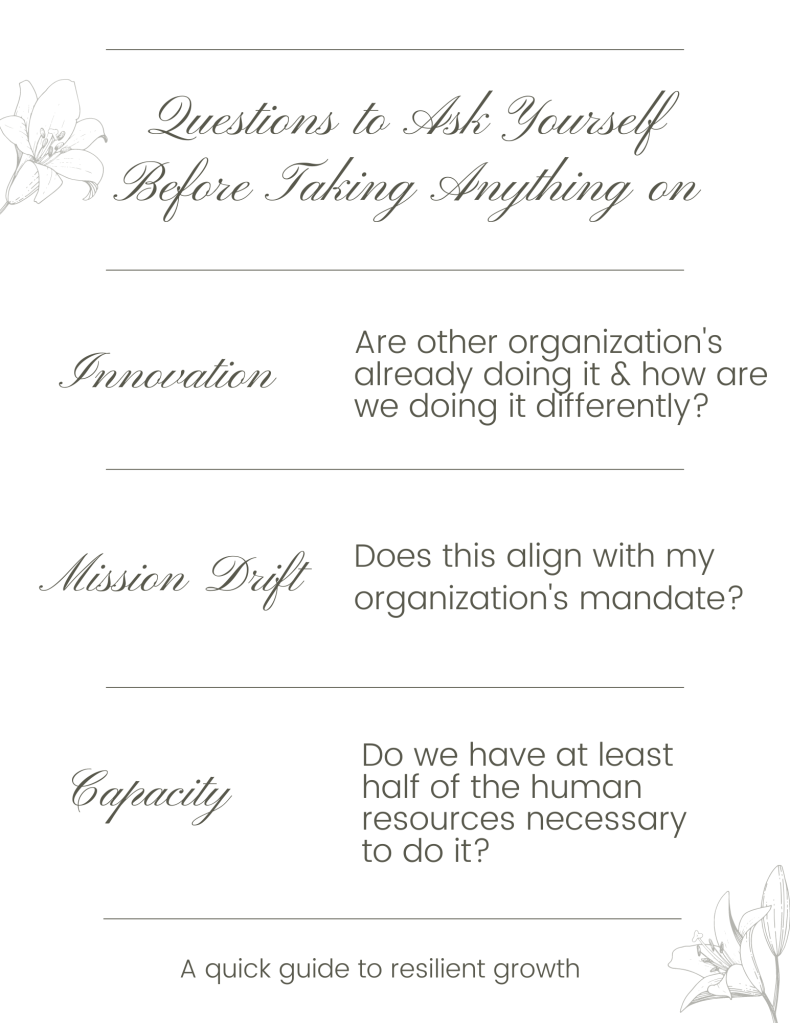
As the days get shorter, it may be tempting to take on more and more projects or initiatives to fill in the void. There is a certain threshold of activities we as humans have the capacity to take on before which we begin to self-induce the pre-conditions of burnout. As a community it is the utmost importance that we support each other to resist burnout. After hearing the wise words of my colleagues at the Regional Development Network, I’ve put together this quick guide for you consider:

Ask yourself these questions in earnest, if your responses are negative then it may not be worthwhile to take on at this point in time. Stay resilient friends!

What is Resilient Growth?

Resilient growth is the social and environmental growth that makes the world a better place. It’s the kind of growth that helps out a neighbor in need; the kind of growth that provides healthy and affordable food; It’s the kind of growth that communities are built on.

It is nearly common knowledge now that infinite economic growth on a finite planet is a recipe for disaster. Growth in our economy has been appropriated by the mainstream to primarily reference metrics such as Gross Domestic Product (GDP) – originally, however, the meaning of growth wasn’t so disconnected and fragmented.

Before neoliberal economics there was the community economy. Growth in the community economy means learning new skills, getting involved in your local community, and adding value to your home. This kind of growth is resilient because it fundamentally gives us the capacity to be more adaptable.

Resilience is the ability to withstand or adjust easily to change. So when enterprises are designed to build the capacity of its workers then they are able to find creative solutions. Additionally when organizations are able to systematically distribute decision making to operate democratically, then they can ensure the best outcomes for everyone involved. For example, during the pandemic the Muskoka North Coop was able to relocate barista workers into their grocery store. They were not only able to retain all their staff by shuffling around their tasks but they actually ended up hiring some of their unemployed user members as well. Since grocery store sales spiked from everyone living at home during this time, they were also able to give a $2.00 per hour wage increase to all their staff which they plan on maintaining after the pandemic subsides.

Designing enterprises to be flexible and collaborative creates the opportunity for a new economic reality. One where we have the possibility to prioritize human needs over corporate greed. Resilient growth is enabling the transformative potential of organizations through worker ownership and community empowerment.

What is a Cooperative?

A cooperative enterprise can take many forms, but the founding principles are all the same. Cooperatives around the world have adopted seven core principles which were officially enacted by the International Co-operative Alliance in 1995; however, the first official cooperative based on these seven principles traces back to Rochdale, England in 1844. The principles are as follows:

  1. Open and Voluntary Membership – No discrimination.
  2. Democratic Member Control – One member, one vote. No exceptions.
  3. Members’ Economic Participation – All members must invest in the coop.
  4. Autonomy & Independence – Never compromise member control!
  5. Education, Training & Information – For continual growth of the membership
  6. Cooperation among cooperatives – Collaborate strategically to meet members’ needs.
  7. Concern for community – Contribute to sustainable community development

All together these core principles outline a new way to do business that goes beyond recycling capitalism with schemes such as the triple bottom line. Cooperatives provide the framework for an inherent power dynamic shift that connects the people making the decisions in a tangible way to the people affected by the decisions.

Cooperatives provide a foundation for reciprocity where people are empowered to not only help themselves but also contribute to broader mission. The cooperative model is able to capture the concern one has for their own welfare and put it towards a greater whole that contributes to the welfare of other members.

Reach out to learn more!